
In the early hours of May 2nd, two children vanished from a house encircled by forest, so dense it swallowed sound itself.
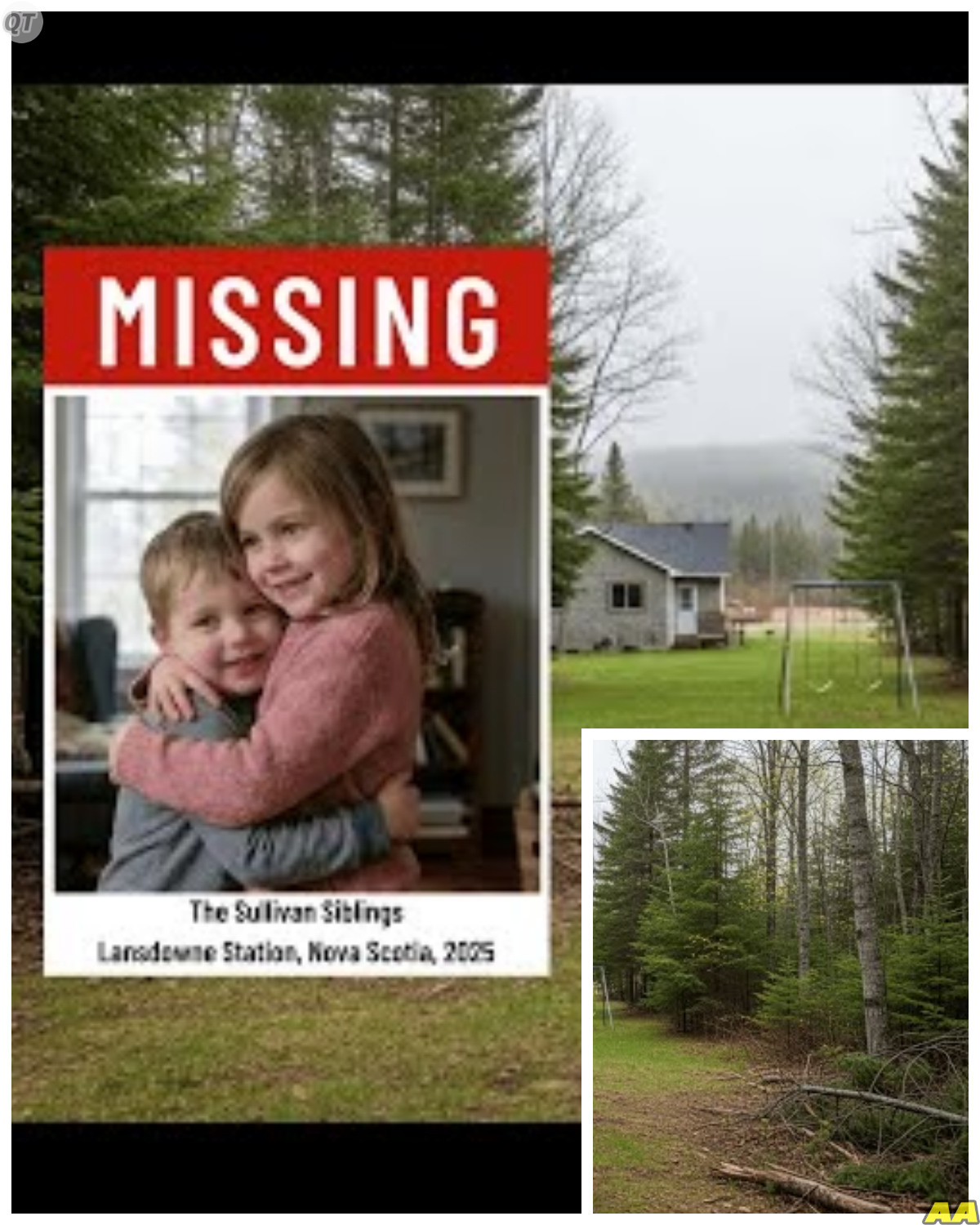
Less than 48 hours later, splintered undergrowth found a small piece of a pink blanket caught high in a tree.
2 days after that, the other half surfaced somewhere it should never have been.
What that torn blanket would ultimately reveal would quietly dismantle the belief that the children had ever wandered away at all.
Lily Sullivan was 6 years old, born in March of 2019, and she took up space in the way only children her age can, loudly, brightly, without apology.
She laughed easily, often at things no one else found funny, her mouth opening wide as her whole body tilted forward with the force of it.
Pink was her color.
Pink shirts, pink pants, pink rubber boots printed with small rainbows already scuffed along the toes from use.
When she left the house, she usually carried a cream colored backpack with strawberries scattered across the fabric.
The straps slipping down her shoulders no matter how many times she adjusted them.
Inside there were usually small treasures, a toy, a scrap of paper, something she didn’t want to leave behind.
She had a pink blanket, too, soft from years of washing.
The edges thinning where her fingers worried them while she fell asleep.
It followed her from room to room, dragged across floors, folded and unfolded without ceremony.
Comfort objects tend to fade quietly into the background of family life until one day they don’t.
At the time it was just part of Lily, another detail in a life made up of many small ordinary things.
Jack Sullivan was four, born in October of 2020, and he moved differently through the same spaces.
Where Lily filled rooms with noise, Jack occupied them carefully.
He watched first, acted later.
His clothes were practical.
Black under arour jogging pants, sturdy rubber boots decorated with blue dinosaurs, but even dressed for movement.
He often stayed close to the adults in his life.
He still wore pull-up diapers, a fact that shaped his days in ways invisible to outsiders but obvious to anyone responsible for his care.
He needed help.
He expected it.
People who knew Jack described him as thoughtful, quiet, the kind of child who seemed to be listening even when he wasn’t speaking.
His eyes, hazel like his sisters, tracked movement more than faces.
When he laughed, it came suddenly, briefly, then vanished again, as if he were surprised by it himself.
They lived with their mother, Malayaia Brooks Murray, in a house on Gerallock Road, a narrow stretch of land in Landown Station where the forest pressed in close on all sides.
Malaya had moved the family there in the late summer of 2023, drawn by affordability in space, perhaps by the promise of quiet.
The quiet came easily, too easily, some would later say.
Cell phone service faded in and out depending on where you stood.
a few steps in the wrong direction and calls dropped without warning.
In emergencies, time stretched.
Daniel Martell lived there, too.
Lily and Jack’s stepfather, and with him, the rhythms of a blended family.
There were arguments, as there are in most households, struggling under financial strain and the demands of young children.
But there were also routines, meals, bedtimes, mornings that began with half awake movement through narrow hallways.
A baby shared the space as well, barely a year old, her needs immediate and constant, pulling attention in a dozen directions at once.
On the same property, though not under the same roof, lived Daniel’s mother, Janie McKenzie.
Her trailer sat close enough that sound carried between buildings when the conditions were right.
The bark of a dog, the metallic creek of swings in the yard, but far enough to allow privacy.
She knew the cadence of the place, the way noise rose and fell over the course of a day.
In rural settings like Landown Station, sound mattered.
It told you who was home, who was awake, whether something was out of place.
The land itself shaped the family’s daily life.
Hurricane Fiona had torn through the region in 2022, leaving behind a maze of fallen trees and tangled roots.
Blowdown littered the woods, making even short walks difficult.
Underbrush grew thick and fast.
Streams cut through the area and lands down lake lay nearby.
Its surface deceptively calm.
To live there was to live with the constant presence of the natural world, not as backdrop, but as participant.
The forest did not observe.
It acted.
For Lily and Jack, the property was simply where they played.
Swings hung in the yard.
Paths formed where small feet ran the same roots again and again.
To them, the trees were familiar shapes, not obstacles.
Children build their own maps of the world, guided less by boundaries than by curiosity.
At school, Lily was known as cheerful, energetic.
There were plans to have her assessed later that spring, appointments meant to better understand how she processed the world.
But those plans sat in the future, abstract and distant.
In the present, she was just a six-year-old girl who liked pink and laughter and the comfort of familiar things.
Jack, younger and quieter, remained closer to home.
His world was smaller, defined by what he could see and reach.
He followed his sister when she let him.
He waited when she didn’t.
From the outside, the family looked like many others living on the margins of rural Nova Scotia, doing their best with limited resources, balancing isolation with the need for connection.
Days passed without incident.
Ordinary decisions stacked quietly on top of one another.
No single moment stood out as a warning.
Sometimes late at night, the forest made noises that sounded almost human.
Branches snapping, wind pushing through broken trunks with a low, hollow moan.
It was the kind of place that reminded you subtly but persistently that control was an illusion, that things could slip away.
But in those days before everything fractured, Lily and Jack were not symbols or subjects of concern.
They were children known, touched, spoken to, loved in imperfect everyday ways.
By the time darkness settled over Gearlock Road on Thursday, May 1st, 2025, it felt complete.
Uninterrupted by street lights or neighboring houses, the forest closed in early, swallowing the last traces of dusk before 9:00, leaving the Sullivan Martell home standing alone, its windows glowing faintly against a wall of trees.
Outside, the air had turned sharply cold, carrying the damp, resin heavy smell of spruce mixed with the sour scent of overturned soil from roots torn loose years earlier by Hurricane Fiona.
Inside, the house moved through its final rhythms of the day.
Dinner had been cleared.
Toys were pushed aside rather than put away.
Somewhere between 9 and 10 p.
m.
, Mallea Brooks Murray walked the children down the narrow hallway toward their bedroom.
The baby stirred in another room, her breathing uneven, the faint hiss of a monitor filling the space between footsteps.
Lily climbed onto her mattress without resistance, already reaching for her pink blanket.
The fabric was worn thin in places, softened by countless washes.
Its edges frayed where small fingers worried at night after night.
She pulled it up beneath her chin automatically.
The motion practiced.
Unconscious, Jack lingered at the doorway, rubbing one bare foot against the other, eyes drifting around the room as if committing it to memory.
“Okay,” Malaya said quietly, crouching to adjust the pull-up at his waist.
Her hands moved with the ease of repetition.
Bedtime.
Thigh.
Jack didn’t answer.
He didn’t need to.
His eyelids fluttered, then sagged.
From down the hall came a sudden cry.
The baby waking sharp and demanding.
Malaya turned her head toward the sound, then back again.
“I’ll be right back,” she said.
Though neither child acknowledged her, Lily had already rolled onto her side, the blanket following her movement like a shadow.
The bedroom door closed with a soft click.
Later, after the baby was settled and the house quieted again, Mallejo went to bed.
Daniel Martell remained awake in the living room.
The television casting low, flickering light across the walls.
The volume stayed muted, more glow than sound.
Shadows stretched and collapsed with every scene change.
Outside, the wind moved through the blowdown scattered across the property.
Branches knocking together with hollow, irregular taps.
The temperature continued to drop, the cold pressing steadily against the walls.
Before turning in, Daniel walked to the front door.
He lifted a metal wrench and balanced it carefully on top of the door frame, wedging it so that any movement would send it clattering to the floor.
That way, we’ll hear it, he muttered, standing back to check its position.
The wrench stayed put.
Sometime after midnight, the night changed.
In the hours between 12 a m and 4 a m, a sound cut through the forest that did not belong to wind or wildlife.
An engine loud, low, repeating.
It came and went, the noise traveling unnaturally far in the still air.
One neighbor, awake in a house set higher on the land, lifted his head as headlights briefly flared over the treetops, illuminating branches where light should never have reached.
The vehicle stopped, then moved again, then returned.
Another neighbor, closer to the railroad tracks near Lands Down Station Road, heard the same engine slow, turn around, and accelerate away.
In a place where the only regular traffic came from logging trucks and locals who knew one another’s routines, the sound felt wrong, distinct, memorable, but at the time it remained only that, a sound in the night, noted and set aside.
Back at the house, the forest closed in again.
The engine noise faded.
The cold deepened inside.
Nothing stirred.
Morning arrived slowly on Friday, May 2nd.
Thin gray light filtering through the trees.
By 6:15 a male was awake, moving through the kitchen with the baby balanced against her shoulder.
The house smelled faintly of cold coffee grounds and damp air.
She opened her phone, logged into the school reporting system, and marked Lily and Jack absent for the day, selecting illness from the list.
The cough from the day before still lived in her mind.
The act felt routine, automatic.
Time passed.
The baby fed.
The kitchen remained quiet.
Around 8:50 a.
m.
m in the nearby trailer, Janie McKenzie woke to her dog barking.
The sound pulled her abruptly from sleep, sharp enough to raise her pulse.
She lay still, listening, until something else reached her ears.
Children’s laughter, light and unmistakable, drifting across the property.
The sound rose and fell, followed by the faint metallic creek of swings moving back and forth.
They’re up early, she murmured to herself, rolling onto her side.
The dog settled.
The sounds faded.
Sleep claimed her again.
Shortly after 9:00 a.
m.
, Malaya walked down the hallway toward the children’s bedroom.
The floor felt cold beneath her feet.
She reached for the door, opened it, and stopped.
The beds were empty.
For a moment, her mind stalled, refusing to align with what her eyes were seeing.
She stepped farther into the room, scanning quickly behind the door, under blankets, into corners.
Lily’s pillow lay undisturbed.
Jack’s small blanket was folded exactly as it had been left the night before.
“Lily,” she called, testing her voice.
Jack.
Nothing answered.
She moved faster now, checking the bathroom, the living room, the kitchen.
Each space offered the same response.
Absence.
Her chest tightened, breath catching.
Daniel, she called louder now.
They’re not here, D5.
He appeared moments later, eyes still clouded with sleep.
What do you mean? They’re gone, she said.
Her hands shook as she reached for the front door.
Daniel checked it first.
The wrench still sat exactly where he had placed it.
He lifted it down slowly, staring at it for a beat, longer than necessary.
That didn’t move, he said.
They didn’t go out this way.
They turned to the back sliding door.
It opened easily.
Cold air rushing inside.
Daniel stepped out into the yard, scanning the tree line, the swing set, the edge of the forest.
“They must have gone out here,” he said, though the words sounded thin even to him.
They split up, moving into the woods, calling out names that echoed briefly before dissolving into branches and brush.
Breath steamed in the cold air.
Thorns scratched its leaves.
The forest absorbed everything.
Then Daniel stopped.
“Did you hear that?” he asked sharply.
Malea froze.
“What?” “I thought I heard one of them,” he said like a scream.
The sound came again.
Or maybe it didn’t.
Before either of them could move toward it, a helicopter passed overhead, its rotors tearing through the air, drowning out everything else.
The moment shattered.
“Lily,” Malaya shouted, panic breaking free.
“Jack!” Nothing answered.
They ran back toward the house.
At 10:01 M, Malaya dialed 911.
“My kids are missing,” she said, her voice tight.
“I can’t find them.
” As she spoke, Daniel stood at the edge of the yard, staring into the forest.
The trees stood motionless, indifferent, keeping whatever had happened hidden within them.
And with that call, the space between an ordinary night and a catastrophe closed completely.
The first patrol car turned onto Gerlock Road just minutes after the call ended, its tires crunching loudly against gravel that had been undisturbed since the early morning.
The sound cut through the quiet like a blade.
Red and blue lights flashed against the trunks of the trees, washing the forest in brief artificial color before plunging it back into shadow.
The air was still cold, the kind that stung the inside of the nose, and the smell of damp earth hung low over the ground.
An RCMP officer stepped out, pulling his jacket tighter as he looked around.
The house, the yard, the treeine that seemed to press forward rather than recede.
“Okay,” he said calmly.
notebook already in hand.
Tell me exactly when you last saw them.
Malaya stood near the doorway, arms wrapped around herself, rocking slightly without realizing she was doing it.
Daniel hovered just behind her, his gaze fixed on the woods as if the trees might suddenly give something back.
“They were in bed,” Ma said.
“Last night between 9 and 10, and this morning,” the officer asked.
“I went to wake them,” she said.
Her voice wavered, then steadied.
They weren’t there.
Within minutes, radios crackled to life.
A vulnerable missing person’s alert was issued.
More vehicles arrived.
Then more people, uniforms, reflective vests, boots already muddy before they reached the edge of the property.
The quiet of the morning fractured into motion and sound.
Doors slamming, voices overlapping, engines idling.
By late morning on May 2nd, ground search and rescue teams from Piktu County began to arrive, followed quickly by volunteers from neighboring regions.
Men and women stepped out of trucks and vans, pulling on gloves, adjusting packs, exchanging quick nods.
Many of them had seen this terrain before.
They knew what it could do to a person.
“This isn’t an easy grid,” one search coordinator said, scanning a map spread across the hood of a vehicle.
“Blow down everywhere.
Visibility’s bad.
They search lines formed.
Shouldertosh shoulder, they moved into the woods with deliberate slowness.
Eyes trained on the ground, on low branches, on anything that didn’t belong.
The forest fought them every step of the way.
Fallen trees forced detours.
Roots grabbed at boots.
Thorns tore at fabric and skin.
The smell of crushed greenery rose thick and sharp as they pushed through underbrush.
Dogs joined the effort.
RCMP police dog services, noses low, handlers following carefully behind, drones buzzed overhead, their mechanical wines slicing through the natural sounds of the forest.
A helicopter circled above, rotor wash flattening branches and sending leaves spiraling into the air.
Thermal imaging scanned the ground below, searching for heat signatures that never appeared.
Hours passed.
By mid-after afternoon, the first and only clear physical trace emerged.
Near a pipeline trail close to Landown Lake.
A searcher stopped abruptly and raised a hand.
“Hold up,” he said.
In the mud, pressed shallow but distinct, was a single child-sized bootprint.
They gathered around it carefully, kneeling, photographing, measuring.
The print was small, too small to belong to an adult.
It suggested movement away from the house, but it was only one print.
No track, no direction, nothing to follow.
It’s something, someone said quietly.
But even as the words left his mouth, the truth settled in.
One print did not tell a story.
It only asked a question.
As daylight faded on the first day, the search expanded outward.
Crews worked until exhaustion set in, their breath fogging in the cooling air.
No clothing, no belongings, no sign of two small bodies that should have been impossible to miss.
That night, flood lights illuminated sections of the property, turning patches of forest into stark, unnatural stages.
The baby cried inside the house.
Radios crackled continuously.
No one slept.
On Saturday, May 3rd, the operation intensified.
More than 160 GSAR volunteers converged on Landsdown station coming from Colchester County, East Hance and beyond.
They moved methodically, grid by grid, covering approximately 8 and 1/2 square km of brutal terrain.
The work was slow, punishing.
Every fallen log had to be checked.
Every hollow beneath tangled roots inspected.
By then, the temperature had dropped low enough at night to raise quiet concerns among medical advisers.
The children had been wearing rubber boots, light clothing, no coats, no thermal layers.
Still, the search continued.
That same morning, investigators pursued another lead.
Malayaia had raised the possibility that the children’s biological father, Cody Sullivan, might have taken them.
It was a thought driven by fear more than evidence.
But in the first 48 hours, no possibility could be ignored.
At 2:50 a.
m.
, RCMP officers knocked on his door.
He answered confused, half asleep.
“I haven’t seen them in years,” he said, his voice thick with disbelief.
“I didn’t take them.
Police verified his alibi.
” Toll footage from the Kobequid Pass showed no sign of his vehicle traveling toward Landown Station.
Within hours, he was cleared.
The lead went nowhere, but time had already been spent.
Back in the woods, frustration grew heavier with every hour.
Searchers returned with torn clothing, scratched faces, hands numb from cold and effort.
Still nothing.
Then, on the afternoon of May 2nd, something else surfaced.
A searcher moving through the trees nearly a kilometer from the house looked up and froze.
Tangled in the branches above him was a piece of fabric, pink, unmistakable against the muted greens and browns of the forest.
It fluttered weakly in the breeze, snagged high enough that it hadn’t been touched by animals or dragged through brush.
They stood beneath it in silence.
It looks like a blanket, someone said carefully.
It was retrieved and bagged.
Family members later confirmed what everyone already suspected.
It belonged to Lily.
The discovery sent a ripple through the operation.
For the first time, something concrete existed, a personal item, a connection between the children and the wilderness around them.
But questions followed immediately.
How had it gotten there? Why only one piece? 2 days later, on Monday, May 5th, the answer grew more troubling.
At the end of the driveway, inside a garbage bag waiting for pickup, another fragment of the same pink blanket was found.
Torn, matching, placed among household trash.
An officer stared down at it, jaw tightening.
The implications settled in without needing to be spoken.
A child does not tear her blanket in half.
A child does not carry one piece deep into the woods and then return the other to the garbage at home.
The search continued.
But something fundamental had shifted.
What had begun as a race against time now carried the weight of contradiction.
Evidence pointed in two directions at once, away from the house and back toward it.
By May 7th, 5 days into the operation, the RCMP gathered media and families to deliver a decision no one wanted to hear.
Staff Sergeant Curtis McKinnon spoke carefully, his words measured.
Based on the amount of time that has passed, the terrain, and the weather conditions, he said, “The probability of survival is extremely low.
” The words landed heavily.
Around him, volunteers stood in silence, faces drawn, mud still caked on their boots.
The massive GSAR effort would be scaled back.
The focus would shift.
Rescue had given way to recovery, and recovery quietly was giving way to something else.
As the crowds thinned and the forest reclaimed its stillness, the unanswered questions only multiplied.
If the children had not wandered away, then where had they gone, and who had taken the time to tear a blanket in two, what happened next would pull the investigation out of the woods and into the home itself? When the search lines dissolved and the last volunteers drove away from Glock Road, the silence didn’t feel peaceful.
It felt watchful, the kind of quiet that doesn’t mean nothing is happening, only that whatever is happening has moved out of sight.
The forest remained where it had always been, thick and indifferent, and the house stayed planted on the edge of it like a witness that refused to speak.
In the days after May 7th, the operation changed shape.
Boots and backpacks gave way to binders and evidence bags.
The case stopped being something you could chase through the woods with a whistle and a dog and became something you chased in conference rooms, in interview chairs, in the sterile glow of computer monitors where thousands of files waited to be watched second by second.
The public heard a phrase that felt both heavy and strangely incomplete.
The disappearance was suspicious.
Another phrase followed almost immediately, as if to soften the blow.
Police said there was no evidence of abduction.
People clung to whichever line made the most sense to them, but the two statements didn’t sit comfortably together, and the RCMP did nothing to tidy the contradiction.
They refused to rule out foul play.
They refused to confirm it.
The case lived in a space between categories where fear could grow without needing permission.
Inside the Northeast Nova District, investigators worked under a different kind of pressure, less visible than the frantic first week, but heavier in its own way.
The children were still missing.
There were no bodies.
No clear trail.
Just a handful of facts that didn’t align.
The wrench balanced on the doorframe undisturbed.
The single bootprint in mud near the pipeline trail and Landown Lake.
And the pink blanket torn into two pieces that had appeared in two worlds that should never touch.
The woods and the trash.
Evidence like that doesn’t shout.
It whispers.
and whispering evidence demands time.
They began methodically because that is what you do when you no longer have ground to cover, only lives to reconstruct.
Interview by interview, statement by statement, the RCMP built a timeline the way you build a case in the dark by touching every surface and noting what feels wrong.
Over the months, they conducted at least 54 formal interviews, adding up to 75 interview sessions in total.
The kind of repetition that isn’t redundancy, but pressure, returning to the same people, the same details at different hours with different questions to see what shifts.
One investigator sat across from a witness, voice, even penpoised.
Start from the beginning, he said, not impatient, not sympathetic, just precise.
Tell me what you heard.
Tell me what you saw.
And tell me what time you believe it was.
Time became the most fragile element of the case.
In a rural place with unreliable cell service, the usual anchors weren’t always available.
Days blurred, nights bled into mornings.
The neighbors who reported the loud vehicle in the hours after midnight, one describing lights over the treetops, another describing a turnaround near the railroad tracks held on to their memories with the stubbornness of people certain they heard something out of place.
Yet, investigators reviewed surveillance footage from the area and said they found no evidence of that vehicle activity.
It created a friction point that would not go away.
Either the witnesses were wrong about the time or the date, or the cameras didn’t see what the ears had heard.
The case did not offer the comfort of a clean answer.
Tips poured in anyway.
More than 1,066 of them.
Each one a small flare launched into darkness.
rumors, sightings, theories, half-remembered details from strangers who suddenly wondered whether the thing they noticed two days ago might matter now.
Investigators chased what could be chased.
They ruled out what could be ruled out, and they logged what could not be proven either way.
Because sometimes all you can do is stack uncertainty neatly and keep moving.
The video review alone became its own kind of endurance test.
They processed roughly 8,000 video files, dash cams, surveillance systems, trail cameras, anything that might have captured movement along roads at intersections near the Kobequid Pass, near the edges of the community where the only regular traffic came from logging trucks and locals.
Watching that much footage is not dramatic.
It is numbing.
It is rewinding the same 10-second stretch until your eyes ache, searching for the flicker of a vehicle where a vehicle should not be.
Run it again, someone would say, leaning in toward the screen.
Pause there, zoom.
A cursor would circle a shape.
A frame would freeze.
And then, most of the time, it would turn out to be nothing.
Early on, one lead demanded immediate attention.
The biological father, Cody Sullivan, Maia, had raised concern that he might have abducted the children and taken them to New Brunswick.
The RCMP treated it seriously because when two small children vanish, you don’t get to dismiss parental possibilities simply because they’re uncomfortable.
Officers went to his home at 2:50 a.
m.
on May 3rd, verified his location, confirmed he had not seen the children for roughly 3 years, and checked toll plaza footage from the Kobequid Pass to make sure he hadn’t traveled into the area.
He was cleared.
The investigation kept tightening around the people who had been closest to Lily and Jack in the final verified window because closeness is not guilt but it is access and access matters.
The last independent sighting remained locked in place.
2:25 p.
m.
on May 1st Doorama in New Glasgow.
The family captured on surveillance footage together.
After that, the timeline relied on statements.
Bedtime between 9 and 10 p.
m.
The absence marked at 6:15 a.
m.
The grandmother’s auditory account at 8:50 a.
m.
The call to 911 at 10:01a m.
Those times became pegs hammered into a wall, and investigators began hanging everything they could from them.
What does it mean that the children were marked absent due to illness before anyone reported them missing? In isolation, it could mean nothing more than routine.
In a suspicious case, nothing stays isolated for long.
The case’s legal posture also became a point of confusion for the public and a tool for investigators.
For months, the RCMP spoke in careful language that seemed to contradict itself.
Suspicious, but often handled under the Missing Persons Act rather than framed openly as a homicide or abduction investigation.
That distinction mattered.
Missing person’s legislation gives police certain avenues to access records and pursue leads related to locating a person without the same threshold required for criminal warrants.
It also reflected a brutal reality.
Without a body, without direct evidence of a crime, the case hovered in a liinal state, serious, resourceheavy, but difficult to push into a prosecutable lane.
By August 2025, documents would indicate investigators no longer viewed the case as actively criminal in nature toward a specific suspect.
Not because suspicion evaporated, but because suspicion is not proof, and the file lacked the kind of decisive evidence prosecutors demand.
It was the kind of bureaucratic phrasing that sounded like retreat to those who loved the children.
Even when the work continued behind closed doors, and the work did continue, the pink blanket remained central, treated not as a sentimental artifact, but as a potential hinge point, something that might carry microscopic traces of what the forest refused to reveal.
The two fragments were subjected to forensic testing, specifically looking for DNA or biological material that could indicate what happened to Lily.
Daniel Martell voluntarily provided a DNA sample for exclusion purposes.
An action that investigators logged and filed in the same neutral manner they logged everything else.
Not as absolution, not as condemnation, simply as a data point placed beside others.
In the public eye, Daniel remained highly visible, giving interviews, repeating the children’s names, insisting they could still be found.
Some people saw determination in it, others saw performance.
But perception is a shifting thing and investigators could not afford to operate on perception.
They had to operate on what could be documented.
Malaya meanwhile withdrew from Daniel almost immediately after the disappearance.
During the search week, she left the property in an ambulance and afterward she cut off contact with him entirely.
In many cases, couples present a unified front.
In others, separation becomes its own kind of pressure because two stories that once moved in parallel begin to drift, then collide.
A quiet tension settled over the community.
Landsdown station wasn’t built for this kind of attention.
It was an unincorporated pocket of Nova Scotia, where people knew the patterns of each other’s days, where unusual sounds at night stood out precisely because nights were usually uneventful.
Now every passing vehicle felt suspicious.
Every dog bark felt like a signal.
People found themselves listening harder, watching more, living with a constant low-grade alertness that made ordinary life feel slightly unreal.
Weeks turned into months.
The search had ended, but the waiting did not.
Investigators kept returning to the same questions, not because they enjoyed the loop, but because unsolved cases are solved when something finally breaks.
An assumption, a witness, a piece of evidence, a relationship.
They reviewed tips.
They revisited statements.
They ran down the edges of the timeline again and again as if by staring long enough, they could force the truth to rise to the surface.
In one interview room, an officer’s voice stayed steady as he slid a sheet of paper across the table.
“We’re going to ask you some questions,” he said.
“And we need you to answer carefully.
Take your time.
” Both Malleia Brooks Murray and Daniel Martell underwent polygraph examinations.
According to documents later released, Martell’s results indicated he was truthful regarding the specific questions asked.
Brooks Murray was also deemed truthful.
Polygraphs in Canada are investigative tools rather than courtroom evidence, measuring physiological stress, not objective fact.
But within an investigation, they function like another lens.
imperfect, controversial, yet sometimes useful for narrowing focus or confirming consistency.
Still, consistency did not equal clarity, and clarity remained elusive.
As the year moved toward winter, the case felt, to outsiders like it was sinking into cold storage.
But inside the RCMP Northeast Nova Major Crime Unit, the file did not close.
It thickened.
A paper war expanded.
references, statements, forensic requests, video logs, thousands of pages accumulating into a record of effort that could not bring the children back.
Then in mid January of the following year, something happened that shifted the case again.
Not in the woods, not in the home, but in a courtroom.
Media organizations petitioned to unseal documents the public had never been allowed to read.
documents that contained the RCMP’s internal theories and details of what witnesses had told them in the earliest days.
The public thought it knew the story.
It didn’t.
And what those documents would reveal would force everyone to look back at the household itself with newly sharpened eyes.
Because the missing pieces were not only out in the forest, they were in the relationships.
And the question remained, what kind of home had Lily and Jack been living in in the days before they vanished? The shift did not begin in the woods or at the house on Gerallock Road or even inside the RCMP detachment where the case files had grown thick and unwieldy.
It began quietly inside a courtroom with paper.
In mid January of 2026, nearly 8 months after Lily and Jack Sullivan vanished, a judge ordered the unsealing of documents that had remained hidden from public view since the earliest days of the investigation.
They were known formally as information to obtain itto documents prepared by the RCMP to justify search warrants.
In practice, they were something else entirely, a snapshot of what investigators had believed when the case was still raw, when fear and urgency had sharpened every observation.
When journalists opened them, the tone was unmistakable.
This was not the language of a wandering off scenario.
This was the language of risk.
Inside those pages, the story of the Sullivan Martal household appeared again, but reframed, stripped of neutrality, heavy with allegations that had never been spoken aloud.
For the first time, the public learned what Malea Brooks Murray had told police in interviews conducted shortly after the children disappeared.
She described a relationship shaped by control, not emotional distance, not incompatibility, control.
According to her statements, Daniel Martell had physically blocked her during arguments, using his body to prevent her from leaving rooms.
She alleged that he held her down, pushed her, and on multiple occasions forcibly took her phone from her hands to stop her from contacting her mother.
She told investigators that these encounters were not only frightening, but painful, that she felt trapped in her own home, isolated by geography and by his behavior.
One passage stood out for its simplicity.
She said he would take the phone so she could not call anyone.
Investigators reading those statements in real time did not treat them as relationship drama.
They treated them as context because context explains behavior.
Context reframes timelines.
Context alters what is possible.
In the ITO documents, the RCMP did not claim these allegations were proven fact.
They did not label Martell a perpetrator, but they did something just as significant.
They documented the risk environment inside the home.
They placed those allegations alongside the disappearance of two vulnerable children and treated the combination as something that demanded scrutiny.
Martell’s response was also documented just as carefully.
He denied any physical violence outright.
He acknowledged that arguments happened, that voices were raised, that finances caused stress, but he rejected the idea that he had ever assaulted or restrained Malahi.
In the documents, his tone was defensive, but firm, his account consistent with what he had said publicly, that the relationship had its ups and downs, nothing more.
Two stories now existed side by side, neither collapsing under its own weight, neither fully corroborated, neither legally actionable on its own.
But together, they changed the gravity of the case.
Because once the household was reframed as potentially volatile, the earlier details began to behave differently.
The wrench balanced on the door frame was no longer just a precaution.
It became an assertion of control over movement.
The unreliable cell service was no longer just an inconvenience.
It became isolation.
The mother marking the children absent due to illness at 6:15a mm was no longer merely routine.
It became a decision that required explanation.
Investigators returned again to the timeline between 2:25 p.
m.
on May 1st, the Dollararama footage and 10:01 a.
m.
on May 2nd, the 911 call.
That window had always been critical.
Now it was radioactive.
They looked again at the neighbors accounts of a loud vehicle in the early morning hours.
They looked again at the RCMP’s own inability to corroborate that vehicle on camera.
They looked again at the grandmother’s auditory account of hearing children laughing at 8:50 a.
m.
An observation that, if accurate, compressed the window of disappearance dramatically.
They did not assume it was false.
They did not assume it was true.
They treated it as a pivot point.
And then there was the blanket.
Investigators had never stopped thinking about the blanket.
But after January 2026, it became something else entirely.
Not a confusing artifact, but a probable act.
The ITO documents made clear that police considered the blanket to be manipulated.
Its two fragments existed in mutually exclusive contexts.
One fragment fit a narrative of wandering.
The other obliterated it.
A child does not partially stage her own disappearance.
Someone had handled that blanket.
Someone had torn it.
Someone had placed one piece in a tree nearly a kilometer from the home.
and someone had put the other piece into a trash bag on the family’s own property.
Whether that person intended to mislead investigators or panicked mid-action or was interrupted, the result was the same.
A trail that contradicted itself.
This was why the RCMP never ruled out foul play.
This was why the case never closed.
And yet, there were still no charges.
Because every path investigators followed ended at the same impass.
No body, no confirmed cause of death, no definitive mechanism of removal.
Canadian law does not bend easily around suspicion, no matter how strong.
Without corpus deliki, the body of the crime, prosecutors hesitate.
Judges demand thresholds and investigators, no matter how convinced, are constrained by what they can prove.
The polygraph results did not resolve the impass.
Both Malleia and Daniel were deemed truthful regarding the questions they were asked.
That did not mean they told the whole truth.
It did not mean they lied.
It meant only that their bodies did not register deception under those conditions.
Investigators understood the limits.
The public less so.
As media coverage intensified following the document release, public opinion fractured.
Some saw the allegations and concluded the truth had finally surfaced.
Others saw the lack of arrests and concluded the investigation had failed.
Online theories multiplied, sharpened, metastasized.
None of them moved the case forward.
Inside the major crime unit, the mood was different.
There was no satisfaction in revelation without resolution.
The ITO documents answered one question.
why the police had taken the case seriously from the start, but they did not answer the only question that mattered.
Where were Lily and Jack? Investigators mapped out the land again.
This time, not with search grids, but with human behavior in mind.
If the children had not traveled on foot, they had been moved.
If they had been moved, a vehicle had been involved.
If a vehicle had been involved, it had either avoided cameras or been missed by them.
If remains had been concealed, they were likely outside the initial 8 1/2 square km search area, somewhere only a person familiar with rural terrain would think to look.
Forestry land, crown land, areas hunters pass through once a year, places where discovery would be accidental, delayed, devastating.
The RCMP did not say this publicly.
They did not need to.
The implication was enough.
In the weeks following the unsealing, one final measure was taken.
Not investigative, but strategic.
The Nova Scotia Department of Justice announced a reward of up to $150,000 for information leading to the arrest and conviction of those responsible for the disappearance of Lily and Jack Sullivan.
Rewards are not gestures of optimism.
They are acknowledgments of stalemate.
Money, investigators know, does what time cannot.
It loosens tongues.
It reorders loyalties.
It turns silence into something costly.
Still, no one came forward.
And so, the case settled into its final, most dangerous phase.
The long wait.
The phase where investigators know the truth exists but cannot force it into daylight.
The phase where relationships crack slowly.
Where guilt, if it exists, has time to erode defenses.
The RCMP did not close the file.
They did not downgrade the effort.
They waited because cases like this do not end with evidence discovered neatly on a desk.
They end when something gives.
And the question, hanging unanswered as winter deepened, was not whether the truth would emerge, but who would break first.
By the time winter settled fully over Nova Scotia, the forest around Gearlock Road looked almost gentle.
Snow softened the jagged edges left by Hurricane Fiona.
Fallen trees disappeared beneath white drifts.
Paths that had once torn its skin and clothing smoothed into something deceptively calm.
To anyone passing through, it might have looked peaceful.
It was not.
The case of Lily and Jack Sullivan remained open, unresolved, and officially unsolved.
No arrests had been made, no charges laid.
The RCMP Northeast Nova Major Crime Unit continued to list the file as active, a word that did not imply motion so much as refusal.
the refusal to let the case slip quietly into a drawer.
The reward stood at $150,000.
Offered by the Nova Scotia Department of Justice for information leading to an arrest and conviction.
The number carried weight, not because of its size, but because of what it admitted.
That investigators believed someone somewhere knew more than they were saying.
That the silence surrounding the case was not empty, only sealed.
Inside the community, life resumed in a way that felt unnatural.
People returned to routines, work, school, errands, but everything was slightly off-kilter, as if the axis had shifted, and no one could quite recalibrate.
Parents watched their children more closely at bus stops.
Dogs barking at night drew longer, looks through windows.
The sound of an engine after dark still made heads lift.
The house on Gearlock Road did not return to normal.
The relationship that had once defined it was gone.
Maleia Brooks Murray and Daniel Martell no longer lived together.
Their separation swift and absolute in the weeks following the disappearance.
Investigators noted it without comment.
Arangement does not equal guilt, but it changes dynamics, loosens alliances, and alters what people are willing to protect.
Malaya withdrew from public view.
There were no press conferences, no extended interviews.
Grief does not always announce itself loudly.
Sometimes it folds inward, quiet and rigid, conserving energy just to survive each day.
Those close to her described a woman living inside a permanent pause caught between the need to remember and the instinct to stop feeling altogether.
Daniel, by contrast, remained visible for longer, his voice carrying through media interviews as he repeated the children’s names, insisting they could still be found.
To some, it sounded like resolve.
To others, denial.
Investigators did not categorize it either way.
Public perception was not evidence.
The RCMP said little in those months.
When asked directly whether they believed foul play was involved.
They returned to the same careful phrasing.
The case was suspicious, and foul play had not been ruled out.
It was a sentence honed to precision, carrying exactly as much weight as the evidence allowed, and no more.
Behind closed doors, the work continued.
Files remained open on desks.
Timelines stayed taped to walls.
Every so often, a tip came in that warranted a second look, a name, a place, a memory that had shifted with time.
Most went nowhere.
Some circled back to the same impasses investigators had faced for months.
The blanket never left the conversation, even without publicly released forensic results.
Its significance endured unchallenged.
Two pieces, two locations, one object that could not be explained by accident or innocence alone.
It remained the quiet center of the case.
The thing no theory could fully absorb without breaking.
Hunters and forestry workers were quietly encouraged to remain alert in areas beyond the original search grid.
Places too vast, too remote to comb methodically.
crown land, logging corridors, the kinds of locations where discovery happens by chance rather than design.
Investigators understood what that meant.
So did the families.
As months stretched on, the absence itself became the most damaging presence of all.
There were no birthdays marked with certainty.
No milestones acknowledged without hesitation.
Lily would have turned seven.
Jack would have turned five.
Each date passed like a question with no answer.
In cases like this, the legal system offers no ceremony, no clean end point.
There is no trial to attend, no verdict to wait for.
Closure becomes a private negotiation, different for everyone involved.
For investigators, it looks like persistence without guarantee.
For families, it looks like learning how to live alongside uncertainty without letting it consume everything else.
For the community, it looks like memory.
People still speak the children’s names quietly, carefully, as if saying them too loudly might make the loss sharper rather than more bearable.
The swings on the property no longer move on their own.
But when the wind is right, they still creek faintly, metal on metal, a sound that carries farther than it should.
The forest remains unchanged.
Trees grow where others fell.
Roots shift beneath the soil.
Whatever happened within those woods left no visible scar.
That too is part of the cruelty.
Nature does not remember for us.
The case waits now for something that cannot be forced.
A confession, a discovery, a moment when someone decides that silence costs more than speaking.
Investigators know this phase well.
It is the long game, the one measured not in days or weeks, but in years.
Until that moment comes, if it comes, Lily and Jack Sullivan remain missing.
Two children who did not simply disappear, but were taken out of the world in a way that left no clear path back.
Two lives that continue to cast a shadow longer than any search grid, longer than any press release.
The story began with names called into the trees, unanswered, and it ends for now the same way.
Somewhere beyond the edge of Geral Road, the truth still exists, silent, intact, waiting.
If you believe these stories deserve to be told with care, with patience, and without sensationalism, consider supporting this work.
Share this episode, talk about it, keep the names Lily and Jack Sullivan in the light.
And if you want to continue following investigations like this, cases that haven’t ended, stories that still need witnesses, subscribe to the channel because attention is not closure, but it is the first step toward it.
News

“¡Antonio David revela secretos oscuros de Rocío Carrasco que podrían destruir su imagen para siempre!” Mở đầu: La tensión entre Antonio David y Rocío Carrasco ha alcanzado un nuevo nivel de escándalo, ya que el exmarido de la famosa ha decidido sacar a la luz secretos tan oscuros que podrían hacer temblar los cimientos de su reputación. “¿Quién necesita un guion cuando la vida real es más dramática que cualquier telenovela?” Con cada revelación, el público se siente más intrigado y horrorizado, preguntándose qué más podría esconder la hija de la famosa Rocío Jurado.r La historia completa está en los comentarios a continuación.
La Verdad Desenterrada: Antonio David y el Escándalo de Rocío Carrasco La noche caía sobre Madrid, y el ambiente estaba…

Telefe en crisis: el futuro de Lizy Tagliani en La Peña de Morfi en peligro tras rumores de despido” La situación en Telefe ha estallado en un escándalo tras los rumores de que Lizy Tagliani podría ser despedida de La Peña de Morfi. “¿Acaso estamos ante el final de una era?”, se preguntan los fans, mientras la incertidumbre sobre su futuro se apodera de las redes sociales. Este drama ha dejado a todos intrigados y preocupados por el destino de Lizy, quien ha sido una figura clave en la televisión argentina. La historia completa está en los comentarios a continuación.
El Futuro en Juego: Lizy Tagliani y el Escándalo de Telefe La noche caía sobre Buenos Aires, y el ambiente…

“¡Escándalo total en C5N! Jorge Rial lanza la bomba sobre Roberto García Moritán: ‘Lo descubrí en pleno escándalo’” La tensión alcanzó su punto máximo en C5N cuando Jorge Rial destrozó a Roberto García Moritán, afirmando que “lo descubrí en pleno escándalo”. Esta revelación ha generado un aluvión de reacciones en las redes sociales, donde los seguidores no pueden dejar de hablar sobre lo que esto significa para la reputación de Moritán. Este drama promete tener repercusiones significativas en la farándula argentina, y todos están atentos a cómo se desarrollará esta historia. La historia completa está en los comentarios a continuación.
La Caída del Rey de la Televisión: Jorge Rial y el Escándalo de Moritán La noche caía sobre Buenos Aires,…

“¡La verdad al descubierto! Andrea del Boca y Silvestre: el oscuro secreto de su hija en adopción que nadie imaginaba” En un giro que nadie vio venir, se ha revelado que Andrea del Boca y Silvestre tienen una hija que fue dada en adopción, un secreto que podría cambiarlo todo. “¿Qué otras sorpresas nos guardan estos dos?”, se preguntan los seguidores mientras la noticia se difunde como pólvora. Este escándalo promete desatar una serie de reacciones que podrían afectar no solo sus carreras, sino también la percepción pública de ambos. La historia completa está en los comentarios a continuación.
El Secreto Oculto: La Verdadera Historia de Andrea del Boca y su Hija Perdida En el corazón de Buenos Aires,…

¡Jorge Rial lanza la bomba! Reflexiona sobre Luis Ventura: ‘Siempre se acuerda de mí’” Las palabras de Jorge Rial sobre Luis Ventura han sacudido el mundo del espectáculo, al afirmar que “siempre se acuerda de mí”. Esta declaración ha dejado a todos preguntándose sobre la verdadera naturaleza de su relación y lo que podría significar para el futuro. La farándula argentina está en alerta, y los seguidores no pueden esperar a ver cómo se desarrolla esta intrigante historia. La historia completa está en los comentarios a continuación.
La Verdad Oculta: Jorge Rial y el Eco de su Pasado La noche caía sobre Buenos Aires, y el aire…

“¡Nancy Pazos lanza la bomba! Su chat con Javier Milei expone la verdad detrás del político” Las redes sociales están en llamas después de que Nancy Pazos decidiera revelar su chat con Javier Milei, sacando a la luz información que podría cambiarlo todo. “¿Estamos ante la caída de un ícono político?”, se preguntan los analistas mientras las reacciones no dejan de llegar. Este escándalo ha dejado a todos intrigados, y el público está ansioso por seguir el desarrollo de esta impactante historia. La historia completa está en los comentarios a continuación.
Los Secretos Revelados: Nancy Pazos y la Caída de Milei La noche en Buenos Aires era oscura, y el aire…
End of content
No more pages to load